
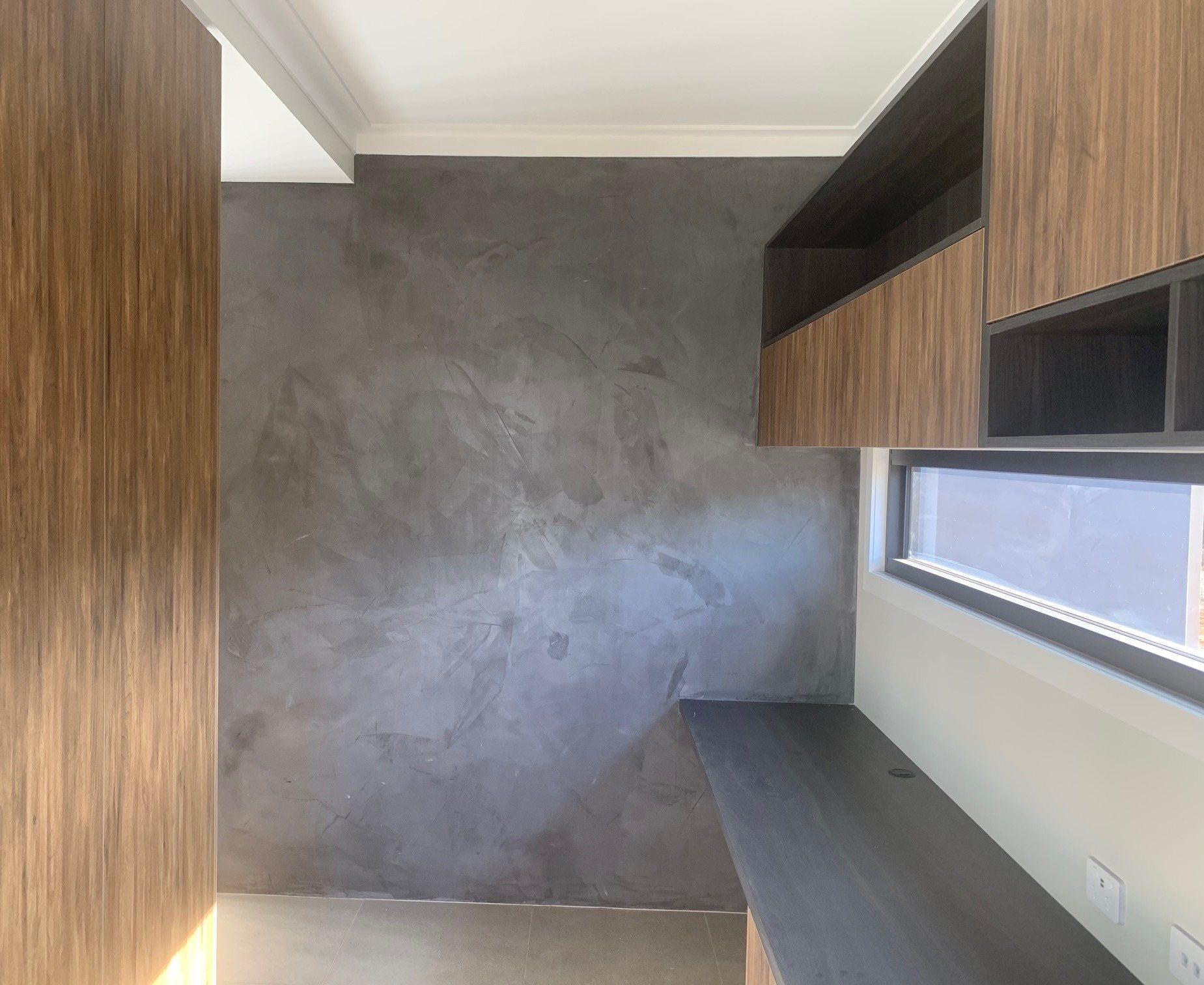
Use microcement where a surface gets walked on, wet or handled, and Venetian plaster where a wall or ceiling is mostly looked at. Microcement covers floors, bathrooms, stairs and joinery, from $200/m² + GST. Venetian plaster covers feature walls, full rooms, ceilings and fireplaces, from $180/m² + GST.
Both are troweled by hand and both give a surface you can't get from paint or tile, which is why they are often compared. But they are different materials doing different work, and most projects that use both put each one where it is strongest.
What is the difference between microcement and Venetian plaster?
Microcement is a thin, hard-wearing coating. The one we install is Decora Diamond Floor, made in Italy, which Decora describes as a single-component decorative finish based on modified polyurethane resins in water with graded aggregates. It is resin-based and silica-free, goes on 2 to 3 mm thick over a prepared substrate, and is sealed to make it water-resistant and easy to clean. It turns floors, walls and wet areas into one continuous surface with no grout lines.
Venetian plaster is genuine slaked lime and marble dust, troweled in thin layers and burnished as it cures. We install the Decora range of Italian lime finishes. Lime is breathable and mineral: it manages moisture rather than trapping it, and the colour sits within the surface instead of on top of it. The result has depth and movement that changes as you walk past.
The short version: one you live on, the other you look at.
Which one goes on floors?
Microcement. Venetian plaster is a wall and ceiling finish and is not made for floors. Microcement runs from kitchen to hallway as one surface and can often go over sound existing tiles without demolition, as it did at Paloma Pizza Bar.
Which one goes in a bathroom or shower?
Microcement, over a certified waterproofing membrane. Venetian plaster is not a wet-area finish, and for bathrooms and showers we specify microcement.
That doesn't make microcement the waterproofing. In a shower, ensuite or laundry, the falls to the waste are set in the floor first, then the Gripset 2P cementitious membrane goes over the whole floor and every wall up to the ceiling, then the microcement goes on top and is sealed. Qualified waterproofers sign a certificate for the membrane, and AS 3740 is the Australian standard that governs wet-area waterproofing. Our waterproofing page sets out each layer.
Which one for a feature wall?
Either, depending on what the wall is for.
- Venetian plaster if the wall is about light and depth: behind a bed, in a dining room, along a hallway that catches raking light. Choose between Incanto (textured matte), Tatto (velvet satin), Carrara (a semi-gloss Marmorino) and Teseo (a travertine stone look).
- Microcement if the wall needs to match a microcement floor and read as one surface, or if it will be knocked and wiped often. At Hank's Bagelry in Chadstone, Chalk microcement wraps the walls and column behind a busy food counter.
Which one for ceilings, fireplaces and curved walls?
Venetian plaster for ceilings and fireplaces. Burnished lime overhead turns a flat ceiling into part of the room, and it wraps fireplaces, columns, arches and curved walls continuously, without joins. For a fireplace surround, the appliance clearances and surface temperature are confirmed with the designer and manufacturer before the finish is chosen.
Which one for kitchens?
Usually both. Microcement for the floor and for benchtops and joinery, where it wraps edges and returns as one surface; joinery starts from $500/m² + GST. Venetian plaster for the walls and features you look at, such as a rangehood or the walls of a living and dining space. For a benchtop, we confirm its exposure to water, heat, oils and cleaning products with a sealed sample before work starts.
Which one for stairs and joinery?
Microcement. Treads and risers can be wrapped as one continuous form, and it follows a radius as easily as a flat panel. At 330 Collins Street, curved seating bases, floor and walls were finished in about 40 m² of microcement over five days. Venetian plaster is not specified for floors or benchtops.
Which one for bedrooms and living rooms?
Venetian plaster suits bedrooms and private spaces well; Tatto's soft, velvety finish is chosen for rooms where restraint is the point. In living areas, a common pairing is a microcement floor with lime plaster walls.
Can I use both in the same room?
Yes, and they are designed to sit together. Both are tinted to order in the same twelve colours, from Chalk to Plaster, so a plaster wall can be matched to a microcement floor. Colour is always confirmed on a hand-troweled sample in your own light, because each material reads slightly differently.
How do they compare on price?
| Microcement | Venetian plaster | |
|---|---|---|
| Starting price | $200/m² + GST (floors and walls) | $180/m² + GST |
| Higher rates | Bathrooms from $350/m², joinery from $500/m² (+ GST) | Higher-sheen finishes cost more |
| Includes | Standard preparation, reinforcement, coats and sealing | Standard preparation, base coats, burnishing and sealing |
Both carry our 7-year workmanship warranty, covering delamination and other installation defects when the care instructions are followed. Our cost guides for microcement and Venetian plaster explain what moves each price.
How do they wear and get repaired?
Microcement is sealed and cleaned with a neutral, non-abrasive cleaner; Decora's guidance rules out steam cleaning, strong acids and alkalis. Installed and sealed properly, it lasts 15 years or more. Small marks can usually be repaired and resealed, though a hand-applied repair may show slightly.
Venetian plaster is dusted and wiped gently, with no abrasive pads. Lime is repaired rather than replaced: a damaged area can be patched and re-burnished in place, and the finish ages into character rather than dating.
Room by room, in short
- Floors, stairs, showers, bathrooms, laundries, benchtops: microcement
- Ceilings, fireplaces, columns, bedrooms: Venetian plaster
- Feature walls and living areas: either, chosen by use and look
- Kitchens: both, microcement below and plaster above
See both materials in detail on our microcement and Venetian plaster pages, or send us your plans and we'll suggest which goes where in your space.