
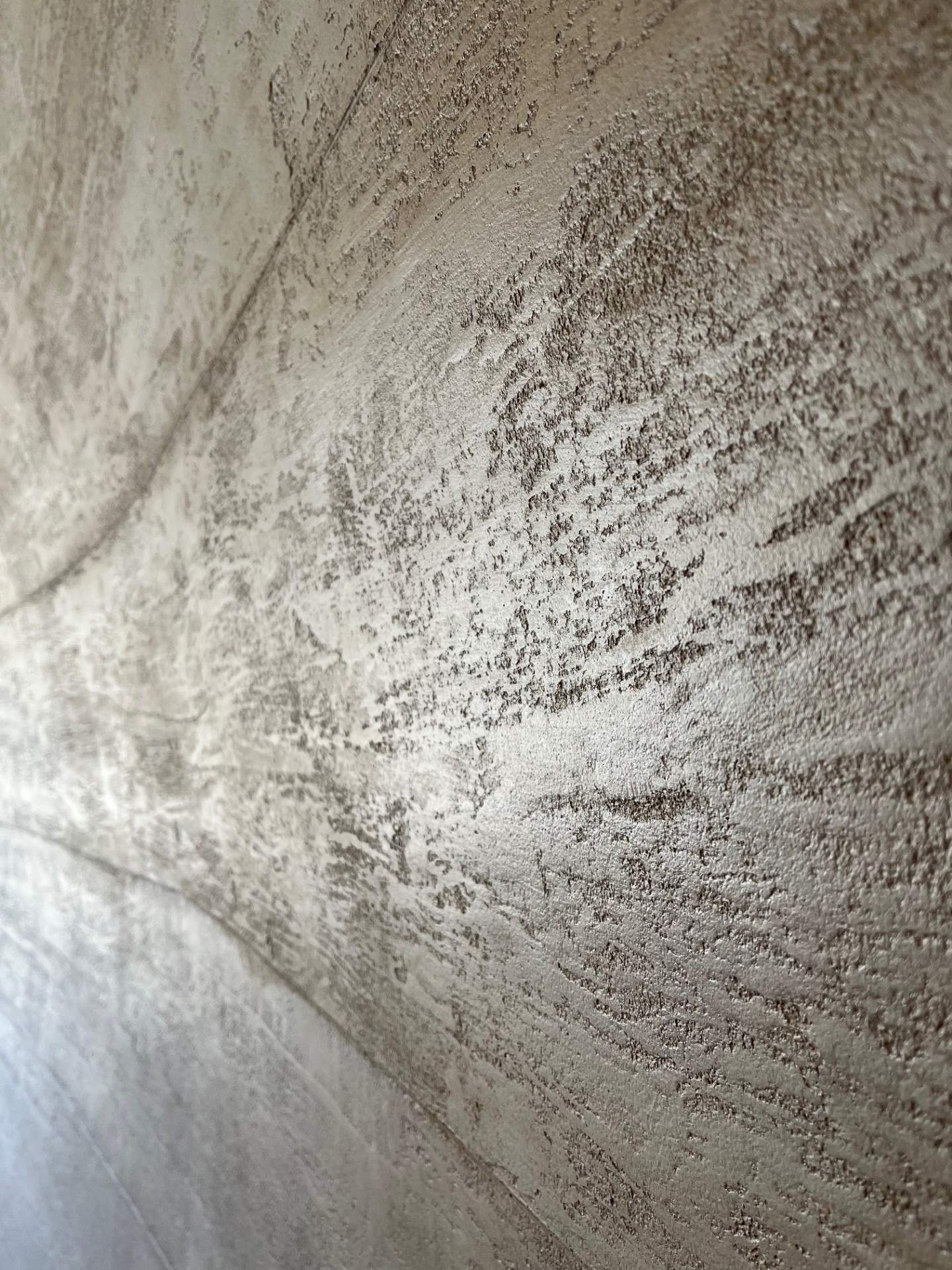
A Venetian plaster wall is made in five stages: the wall is prepared, primed, given a base coat of lime plaster, worked to its final texture and sheen with a steel trowel, and protected where the finish calls for it. The decorative coating itself is thin. Across the four Decora finishes we install, the published thickness runs from about 0.8 mm to 1.5 mm.
The depth you see comes from how the lime is laid and compressed by hand, not from its bulk, which is why every stage before the first coat matters.
What is Venetian plaster made of?
Genuine slaked lime and marble dust. We install the Decora range of Italian lime finishes, tinted to order in our twelve colours, so the colour sits within the plaster rather than being painted on top.
Lime hardens by slowly taking carbon dioxide from the air and turning back into limestone, so it keeps curing after it goes on and the tone can settle slightly over the first weeks.
What happens before the first coat?
The surface is agreed before the wall is touched.
- A physical sample. It sets the colour, but also the trowel scale, the direction of the strokes, the texture, the sheen and how much movement you want. For a travertine look, it also sets the density of the pores and the contrast between open and polished areas.
- A site sample for big surfaces. On a long wall or a ceiling, raking light shows every variation, so we review a sample in place under the lighting the room will actually have.
- Where the finish stops. We agree the edges at doors, ceilings, skirtings and joinery, and which corners, reveals, curves and columns are included.
- Services done first. Power points, switches and other cut-outs are finished before plastering, because cutting into a burnished wall afterwards leaves a repair that can show.
How is the wall prepared?
Plaster shows what is underneath, so preparation depends on the wall.
- Plasterboard: joints, screw heads and repairs completed, sanded evenly and dusted off before priming.
- Concrete, masonry or render: checked for curing, strength, loose surface material, porosity and moisture, with defects repaired and the surface levelled where it would affect the finish.
- Painted walls: the paint is identified and its adhesion tested. Weak or flaking material comes off, and an uncertain surface is trialled first.
- Existing lime plaster: checked for soundness and how much it absorbs, with hollow or weak areas repaired.
- Damp or cracked walls: the cause is fixed first. A decorative coat is not a structural repair, and lime laid over an active damp or movement problem will show it.
Why does the primer matter?
Because lime is sensitive to how quickly the wall draws moisture out of it. A wall that absorbs unevenly, such as fresh plaster beside a patched joint, dries the coat at different speeds, which can show as shadowing. The primer evens that out and gives the lime something to grip. Decora specifies the primer for each finish and substrate, so we follow the product data.
How are the coats applied?
The lime is troweled on in thin, overlapping strokes. The base coat builds the body of the finish, and the following coat or coats are worked while still workable to create the texture and movement agreed on the sample.
Each finish is worked differently:
- Incanto is left textured and matte, with a slightly irregular, worked surface.
- Carrara, Decora's Marmorino, is worked smooth to a semi-gloss.
- Teseo is scratched and smoothed in places to read as travertine stone.
- Tatto is laid smooth for a soft, velvet satin.
A coat is carried from one corner to the next without stopping. If a coat is left to dry partway across a wall, the join can show once the surface is burnished.
What does burnishing do?
Burnishing is pressing and polishing the plaster with a steel trowel as it firms up. The pressure compresses the surface and lays the marble particles flat, which is what brings up the sheen and makes the colour look lit from within. More passes give more shine, which is why higher-sheen finishes take more hand work and cost more.
Is Venetian plaster sealed or waxed?
Sometimes. Decora lists Natural Wax and Marseille soap protectors for smooth interior lime finishes, and protection makes a wall easier to wipe. It also changes the look slightly, so it is applied only after it has been tested on the sample and approved. Some walls are left without it.
How long does it take?
A feature wall usually takes a few days on site; a full room or ceiling takes longer. Each coat dries before the next, and drying depends on temperature, humidity and airflow, so we set the programme after seeing the walls. Decora's data sheets give an application range of 10 to 30 °C with relative humidity below 85%, which matters in a cold Melbourne winter.
What goes wrong, and how is it avoided?
- Shadowing or patches: uneven suction or skipped repairs. Prepare and prime the whole surface evenly.
- Joints showing through: plasterboard not finished flat. Check the wall under raking light before priming.
- Cracking: movement or damp in the wall. Fix the cause first and respect the building's joints.
- A wall unlike the sample: different light or technique. Agree the sample under the room's own lighting and record it.
Can Venetian plaster go in a shower?
No. Venetian plaster is a finish for walls and ceilings you look at, not for showers, floors or benchtops. For a shower or bathroom we specify microcement, and even then the microcement is a decorative finish, not the waterproofing.
In our bathrooms, the falls to the waste are set in the floor first. Then qualified waterproofers apply the Gripset 2P cementitious membrane over the whole floor and every wall up to the ceiling and sign a waterproofing certificate. AS 3740 is the Australian standard for wet-area waterproofing. Only then does the microcement go on, followed by its sealer. Our guide to microcement bathrooms and waterproofing sets out each layer.
For walls that are knocked and scrubbed daily, microcement often suits better, as behind the food counter at Hank's Bagelry.
How do you look after a Venetian plaster wall?
Dust it gently, and wipe marks with a soft damp cloth. Avoid abrasive pads and hard scrubbing in one spot. If a wall is chipped or stained, ask us before treating it: lime is repaired rather than replaced, and a damaged area can be patched and re-burnished in place, though a local repair may remain slightly visible.
Our installations carry a 7-year workmanship warranty covering delamination and other installation defects, provided the care instructions are followed. Structural movement in the building is not covered.
Venetian plaster starts from $180/m² plus GST installed, with higher-sheen finishes costing more; our cost guide explains what moves the price, and designers can use our specification guide. If you have a wall in mind, send us photos and the room it's in, and we'll suggest a finish and a sample to start from.