
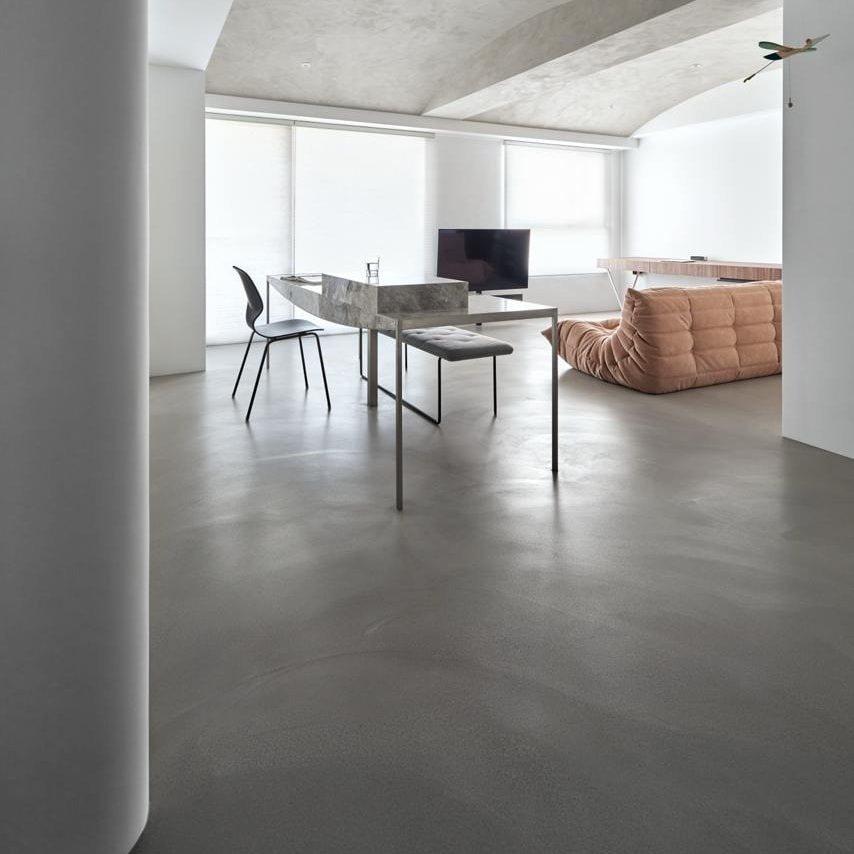
Polished concrete is the concrete slab itself, ground back and polished. Microcement is a coating 2 to 3 mm thick, troweled by hand over a slab, existing tiles, walls, stairs or joinery. So the first question isn't which looks better, but what you are starting with: if you don't have the right slab, or you want the look on anything other than a slab floor, polished concrete isn't an option.
Both give a calm, continuous floor without a grid of grout lines. They get there in completely different ways, and that decides which one suits each room.
What is the difference between microcement and polished concrete?
Polished concrete is made by grinding the top of a concrete slab with progressively finer diamond tooling, usually hardening it with a densifier, then polishing and protecting it. Nothing is added on top: what you see is the slab, including its stone, its colour and anything that has happened to it.
Microcement is a finish applied over a prepared surface. The one we install is Decora Diamond Floor, which Decora describes as a single-component decorative finish based on modified polyurethane resins in water with graded aggregates. It is resin-based and silica-free, goes on in thin coats by hand, and is sealed to make it water-resistant and easy to clean.
Do I need a concrete slab?
For polished concrete, yes, and the slab has to suit polishing. The best results usually come from a slab poured with polishing in mind, because the mix, the stone and the way it was finished all show once it is ground. An existing slab is less predictable: patches, old adhesive, cracks, services trenches and colour differences between pours all come through.
For microcement, no. It goes over most sound substrates: concrete, screed, sound existing tiles, cement sheet and plaster walls, and timber or framed floors where the whole floor assembly has been accepted in writing with an approved overlay. Patches and repairs in the substrate are covered by the coats above.
Which one can go over existing tiles?
Only microcement. Polished concrete needs a slab to grind, so a tiled floor would have to come up, and the slab beneath may not be fit to polish once the adhesive is removed.
Microcement can go over sound, well-bonded tiles without demolition. At Paloma Pizza Bar in Hawthorn, about 60 m² of custom terracotta microcement went straight over the restaurant's existing floor in five days. The tiles were ground back in full, drummy tiles were lifted and the voids filled, and a reinforcing mesh coat bridged the old grout lines before the coloured coats and sealer. Our guide to microcement over existing tiles explains the preparation.
Which one can go on walls, stairs and joinery?
Microcement. Polished concrete is a floor, and only where there is a slab. Microcement carries the same finish up walls, across stair treads and risers, and over benchtops and joinery. At 330 Collins Street, around 40 m² covered curved plywood seating bases, the floor and the walls, so every surface in the room reads as one material.
Which one for a bathroom or shower?
Microcement, over a certified waterproofing membrane. Neither surface is waterproofing on its own.
In our bathrooms, the falls to the waste are formed in the floor first. Qualified waterproofers then apply the Gripset 2P cementitious membrane over the whole floor and every wall up to the ceiling, and sign a waterproofing certificate. AS 3740 is the Australian standard for wet-area waterproofing. The microcement goes over the cured membrane and is sealed, and the building's movement joints are carried through in silicone. Because microcement is only 2 to 3 mm thick, it follows the surface below, so the falls must be right before it goes on. Our guide to microcement bathrooms and waterproofing sets out every layer.
With polished concrete, the slab is the finished surface, so the falls have to be formed when it is poured and the waterproofing has to be resolved with the designer and building surveyor from the start. That is one reason polished concrete is uncommon in showers.
Which one will crack?
Concrete cracks, and polishing doesn't hide it: any crack in the slab stays visible in the finished floor, along with the saw-cut control joints.
Microcement follows what is underneath it. Hairline cracks in the substrate can be bridged with the right preparation and reinforcement, but structural movement has to be dealt with first. The building's movement joints are carried through the microcement, so on a slab with saw cuts the joints remain in both finishes. Our 7-year workmanship warranty covers delamination and other installation defects when the care instructions are followed; cracking from structural movement in the building is not covered.
Which one gives more control over colour?
Microcement. It is tinted to order in our twelve colours, from Chalk to Plaster, or mixed to suit a project, like Paloma's terracotta, and the colour is matched to a hand-troweled sample in your own light before work starts. Polished concrete's colour and stone come from the slab, so the result is partly decided at the concrete plant and partly revealed by the grind.
What about dust and silica?
Grinding concrete releases crystalline silica dust, which is why concrete grinding needs proper extraction, wet methods or both. Microcement preparation can involve grinding too, such as taking tiles or a slab back to a sound surface, and we control that dust with extraction and protective equipment. The difference is the material that stays in the room: Decora Diamond Floor is formulated without crystalline silica, so the finished surface contains none. Our post on silica-free microcement explains why that matters.
How do they compare in cost?
Microcement starts from $200/m² plus GST for floors and walls, including standard preparation, reinforcement, coats and sealing. The final price depends on area, the substrate and the detailing; our microcement cost guide explains what moves it. Polished concrete costs depend heavily on the slab and the level of grind, so compare quotes on the same floor rather than on a headline rate, and ask what preparation and protection each includes.
Which one suits commercial spaces?
Microcement suits cafés, restaurants, retail, offices and showrooms, where a seamless, easily cleaned floor and a designed colour matter. At Kivari, a light microcement floor runs from the shopfront window to the fitting rooms. It is not a finish for heavy industrial floors or forklift traffic; that is where a ground and polished slab belongs.
Room by room, in short
- New ground floor slab, open living or kitchen: either, if the slab is poured for polishing; microcement if you want a set colour or the finish to continue up walls and joinery.
- Renovation over tiles or a patched slab: microcement.
- Upper floors and framed floors: microcement, only with an accepted floor assembly and approved overlay.
- Bathrooms, showers and laundries: microcement over certified waterproofing.
- Walls, stairs, benchtops and joinery: microcement.
- Warehouses, workshops and forklift areas: polished concrete.
If you're weighing up a floor, send us your plans or photos of what's there now and we'll tell you whether microcement suits it.