
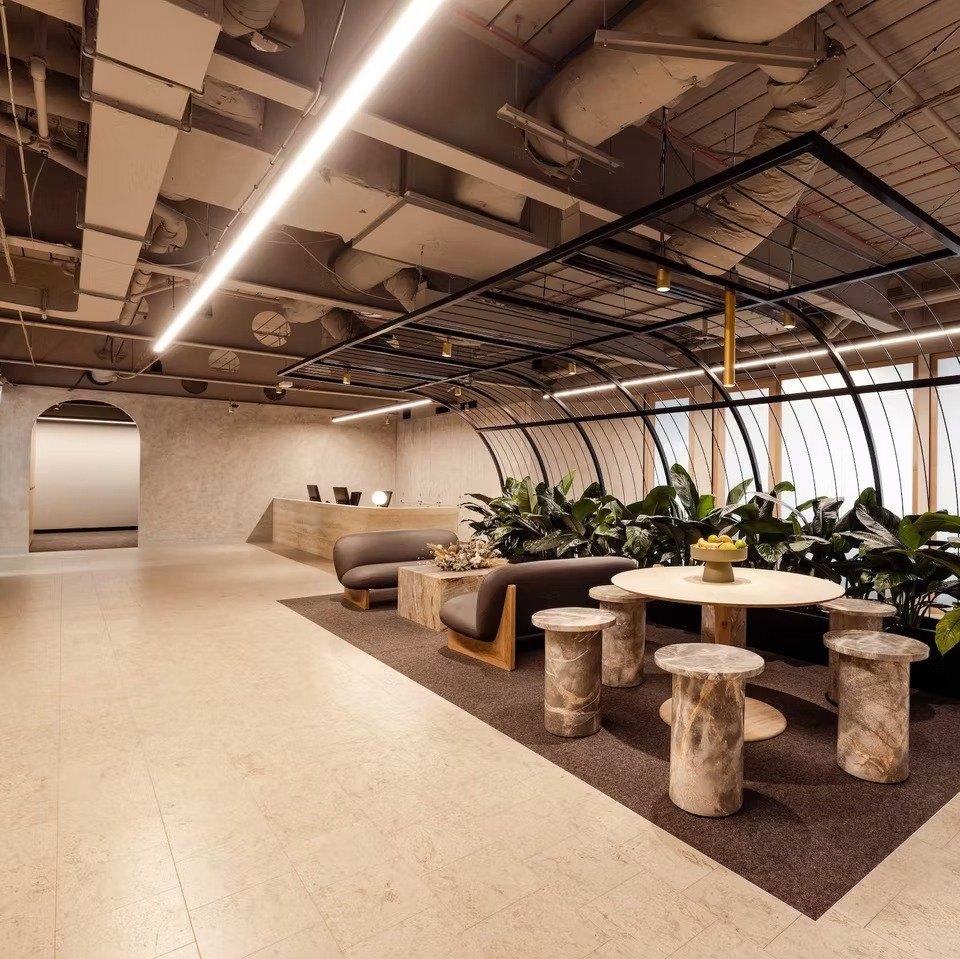
New Generation Cork is a pre-finished, pre-glued cork floor tile: a decorative cork veneer over a dense cork core, with a hard-wearing factory finish already on it. In Melbourne we install it from $275 per square metre plus GST (based on a 50 m² floor), in homes and quieter commercial spaces, on dry interior floors.
Here is what the tile is made of, how it goes down and where it does and doesn't belong.
What are New Generation cork tiles made of?
Each tile has four parts, from the top down:
- A factory finish: a hot-melt coating under three water-based coats, in a satin sheen. Cork Imports' website calls the hot-melt layer ceramic; the manufacturer's technical sheet names the system WEARPLUS, a polyurethane hot-coat with Microban antimicrobial protection.
- A decorative cork veneer: the face you see, which gives each colour its pattern.
- A high-density agglomerated cork core: over 500 kg per cubic metre, which is what lets a soft material take real traffic.
- A factory-applied adhesive backing, which bonds to the adhesive we apply to the subfloor.
The edges are micro-bevelled on all four sides, so the joints read as fine lines rather than a flat sheet. The tile is 86% renewable cork and FSC chain-of-custody certified. The bark is stripped by hand without felling the cork oak, which regrows it.
How is it different from old cork tiles?
Traditional cork tiles were usually raw cork, glued down and then sealed on site, so the floor depended on a coating applied in site conditions. New Generation tiles arrive with the finish done in the factory. There is no sanding, varnishing or curing on site, and once the last tile is laid the floor can be walked on.
The trade-off is that the tiles have a veneer face, so they cannot be sanded back and re-polished like solid cork. After many years of wear, the finish can be lightly buffed and recoated with a satin, non-yellowing two-pack waterborne polyurethane, and a damaged tile can be cut out and replaced on its own. That is why we suggest keeping a few spare tiles from the same batch.
What sizes and colours does New Generation Cork come in?
There are ten tones, from near-white Madeira White and stone-like Sandstone to honey tones such as Copenhagen and the dark Twist Olive. You can see each one on our cork tiles page.
The core range is 6 mm thick. Eight of the ten tones come in 600 x 300 mm, six of those also in 305 x 305 mm, and Harmony and Traditional come in 305 x 305 mm only. The Premier Collection adds larger and thicker tiles: Calais Cream in 600 x 450 x 8 mm and 600 x 300 x 10 mm, Twist Olive in 600 x 450 x 8 mm, and Madeira White in 600 x 600 x 6 mm. It costs more. Sizes vary by colour, so we confirm the exact tile before quoting.
Every tile differs a little, so choose from several tiles laid together, not a single sample.
How do the tiles perform?
The supplier publishes test results for the tile as made:
- Wear: class 23 for high-traffic homes and class 32 for medium-traffic commercial areas (EN ISO 10874).
- Sound: a 14 dB reduction in impact sound (ΔLw, EN ISO 10140-3), so footfall is softer and rooms sound calmer.
- Slip: P2 as supplied (AS 4586 wet pendulum), or P4 with a post-installation polyurethane sealer containing an anti-slip additive.
- Fire: class Cfl-s1 (EN 13501-1).
- Emissions: Greenguard Gold and French A+, with no formaldehyde-containing materials added.
These values describe the tile, not your whole floor. In apartments, the impact-sound rule applies to the full floor build-up, so we check what your building or owners corporation requires first. Every published value is in our cork specification guide.
How is a New Generation cork floor installed?
In this order:
- Inspect and test the subfloor. Moisture in the subfloor must be below 5.5%. A slab on the ground or in a poorly ventilated spot gets a moisture barrier first.
- Acclimatise the tiles. Unopened cartons and the adhesive sit in the room for at least 48 hours. While laying, the room is kept between 15 and 25 °C and 35 to 65% relative humidity.
- Prepare the base. Paint, grease, silicone and dust come off and cracks are filled. Uneven slabs get a levelling compound that must dry fully first; adhesive is never used to fill hollows. Cork never goes straight onto floorboards: loose boards are fixed and a hardboard underlay goes down.
- Set out. Tiles run in a staggered, half-brick pattern from the centre of the room, usually along its length or towards the main window. Cartons are shuffled so the natural variation spreads evenly.
- Prime and bond with the supplier-specified primer and contact adhesive. The product warranty depends on that system.
- Finish the edges and transitions to other floors, then hand over.
The subfloor is where most cork floors succeed or fail: a ridge or hollow left in the slab will show in the finished floor.
Where does cork work, and where doesn't it?
Cork suits living areas, bedrooms, studies, music rooms, upstairs rooms and quieter commercial spaces such as studios, clinics and boutiques. It works over hot-water or electric underfloor heating, with the floor surface kept to a maximum of 28 °C.
It is water-resistant, not waterproof. It copes with everyday spills wiped up promptly, but it should never be wet-mopped, and it does not belong in showers or wet bathrooms. Powder rooms are usually fine; laundries we assess room by room.
For full wet areas we specify microcement instead, and it is worth being clear about why that works. Microcement is a decorative finish, not waterproofing either. In a wet area, a certified waterproofing membrane goes underneath it, over a substrate with the falls to the waste already formed, as AS 3740 (the Australian standard for internal wet areas) requires. Qualified waterproofers install and certify the membrane; the microcement and its sealer go on top. Our guide to microcement bathrooms and waterproofing explains each layer.
How do you look after a cork floor?
- Sweep or vacuum with the brush head down, and clean with a pH-neutral cleaner on a microfibre mop.
- Never wet-mop or steam-clean, and avoid bleach, ammonia, vinegar, wax and abrasive cleaners.
- Use felt pads under furniture and blinds where strong sun falls: cork, like timber, can change colour in the sun.
- Keep rugs off for the first three months, and avoid rubber or vinyl-backed rugs.
The cork FAQ has more.
What warranty comes with it?
The tiles carry the supplier's lifetime structural guarantee, and a warranty against the finish wearing through of 15 years residential or 5 years commercial, under normal use and proper maintenance. Separately, our installation carries a 7-year workmanship warranty covering delamination and other installation defects, provided the care instructions are followed. Structural movement is not covered.
What does it cost?
From $275/m² plus GST installed, based on a 50 m² floor, with standard preparation included. The range, the condition of the subfloor and the layout move the price. Our cork flooring cost guide explains what is included and what is quoted separately.
See it in person
Cork is best judged underfoot and in daylight, so see the range at our Preston showroom, and browse our projects. When you are ready, tell us about the floor: the rooms, what is there now and a few photos, and we will come back with an itemised quote.